
The Trap
A Piece Moves on the Board

Author’s Note
This chapter picks up immediately at the end of The Doctor Speaks.
The speech may be ending — but the performance is only beginning.
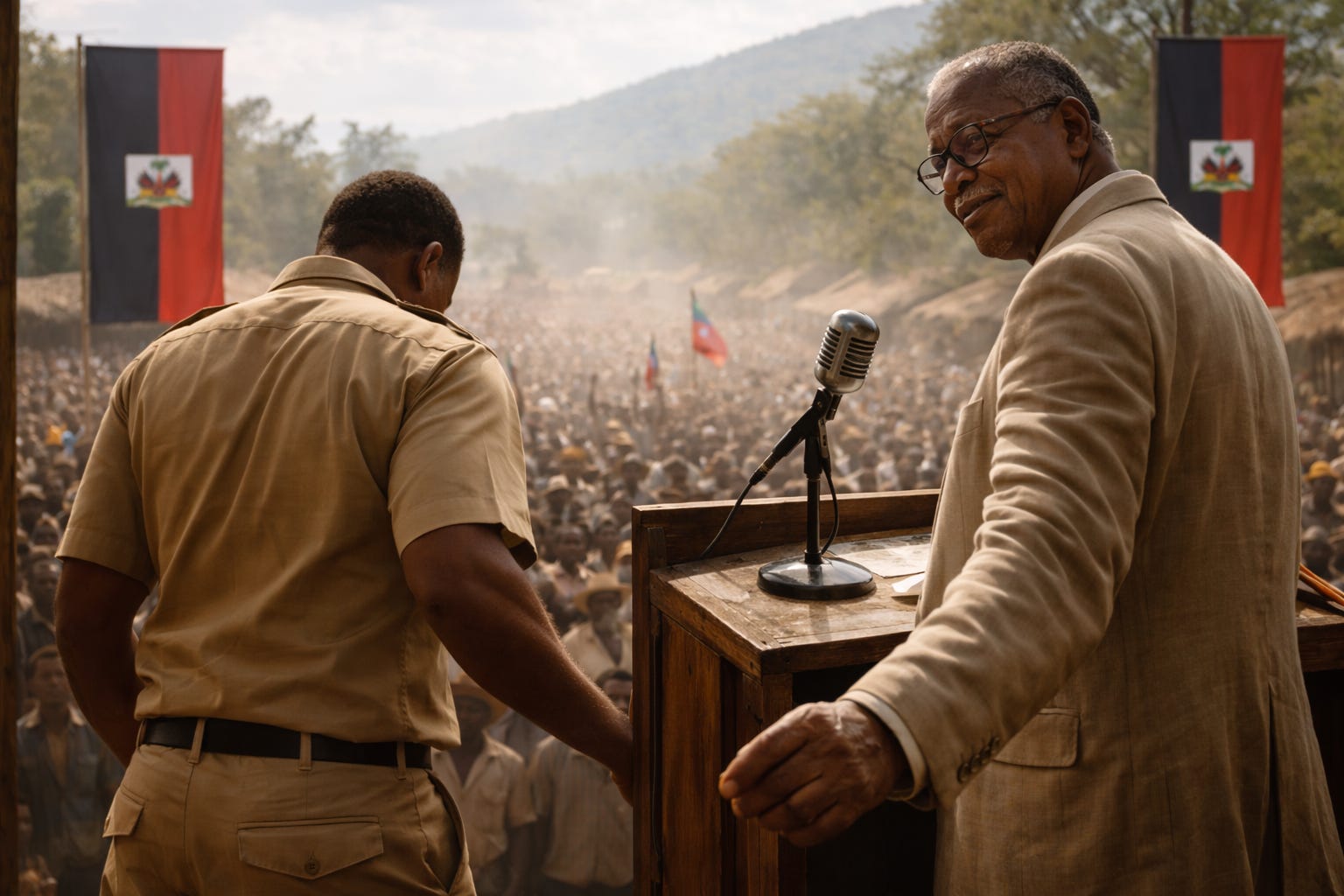
The doctor was nearing the inevitable end of his speech.
He aired out a litany of petty grievances, telling his followers who their sworn enemies were — and why they should be made to pay.
A keen observer of politics can always identify a wannabe despot early on. They always begin by naming the enemy — never with proof, only conviction. They are masterful in the sinister game of us versus them, and the list of “thems” you’re meant to fear and fight only grows denser over time.
“M’pap abize pasyans nou anko, zanmi’m yo,” he said, with an almost apologetic smile.
(I won’t abuse your patience any longer, my friends.)
“But as a traveling doctor, I’ve never had the luxury of calling many people friends,” he continued, winding toward his close. “Yet there’s a man among you who has embraced me in this community with open arms. It’s the inspiration I’ve drawn from the work he and I began in the most remote corners of these provinces that gives me the courage to stand before you as a candidate in the next election.”
He smiled again.
“I don’t want to put you in the spotlight, Prefect André, but your people would love to see you up here at this moment.”
He extended a hand toward Jean-Michel.
“Men nan la men… n’ap rive lwen.”
(Hand in hand… we’ll go far.)
Jean-Michel’s face tightened.
He hadn’t come as a rallygoer but as the préfet of Deschapelles — the man meant to keep order, not take the stage.
Why is he calling me up there?
If he’d asked first, I’d never have agreed to this.
The crowd, already teetering toward frenzy, began to chant:
“Doktè a se préfè a, préfè a se doktè a!”
(The doctor is the prefect, the prefect is the doctor!)
The chant rolled in waves.
The prefect made his way to the stage.
He did not smile. He did not look awkward. Just stern. Stoic. Unamused.
Jean-Michel greeted the doctor with a diplomatic handshake and acknowledged the crowd with a brief wave. As his arm lingered in the air, Doctor Duvalier seized it, performing that contrived gesture of mutual endorsement politicians and their acolytes perfect by instinct.
Jean-Michel lowered both their arms and converted the moment into a controlled embrace — his way of reclaiming the scene.
The crowd was too feverish to notice the quiet pissing contest unfolding above them.
Jean-Michel pivoted, already preparing his escape.
Then Duvalier leaned into the microphone.
“Préfet André is a man of few words,” he said, a perverse grin flickering across his face. “But I’m sure you’d all like him to di de mo pou nou jodia—”
(say a few words for us today.)
The prefect erased the cringe from his face.
He stepped toward the microphone.
“Jodi a se jou doktè a,” he said flatly.
(Today is the doctor’s day.)
“Nou tout la pou nou tande sa l ap di a, epi deside pou tèt pa nou.”
(We’re all here to hear what he has to say, and decide for ourselves.)
“Nou konnen doktè a kòm doktè; chèche konnen l kòm politisyen tou.”
(You know the doctor as a doctor; get to know him as a politician too.)
And with that, Jean-Michel practically fled the stage — like a desperate soul searching for passage to a better beyond.
A man in the front row burst out laughing.
“Se sa m konnen… Préfè a pa nan pale anpil ak moun!”
(That’s what I know… the prefect isn’t one for talking to people!)
Those within earshot joined in.
They all knew what it took for Jean-Michel André to stand at a microphone.
He was accustomed to addressing crowds with a megaphone — issuing orders, dispersing tensions, restoring calm. But a public speaker? A man meant to stir hearts or win applause?
That had never been his calling.
The cheers behind him still rolled in waves — part genuine support, part leftover euphoria from the doctor’s theatrics.
He did not look back.
Better they saw him as the no-nonsense préfet who barely tolerated public speaking than as a politician thirsty for applause.
But as he reached the bottom of the steps, something tightened in his spine.
He could feel Duvalier’s gaze burning into the back of his neck — assessing, measuring, calculating.
The doctor was still smiling.
That unsettling, self-satisfied smile.
The kind a man wears when a piece on the chessboard has moved exactly as he wanted — even if the piece doesn’t realize it yet.
Jean-Michel didn’t need to turn around to know it.
He had seen that smile before.
He kept walking — not toward the crowd, but toward the edge of town — as though he could outrun the feeling creeping up his back.
That something had shifted today.
G, A speech ends. A piece moves. The board changes. This chapter is where the trap closes quietly. The best thing you did here was create this uncomfortable knowing. Well done, my friend.