

Author’s Note
This chapter takes an in-depth look at the complex psychological seduction at the heart of the narrative. We often view historical figures as monolithic, but here we see Duvalier not as the “Papa Doc” of later years, but as a calculated strategist—a “doctor” diagnosing a political illness and prescribing a partnership to a man he couldn’t simply command.
The character of Jean-Michel André represents a tragic intersection of noble intent and ruthless pragmatism. His desire to see the “ti nèg” gain power wasn’t born of a desire for tyranny, but of an exhaustion with an elite that viewed the majority of the nation as incapable of governance.
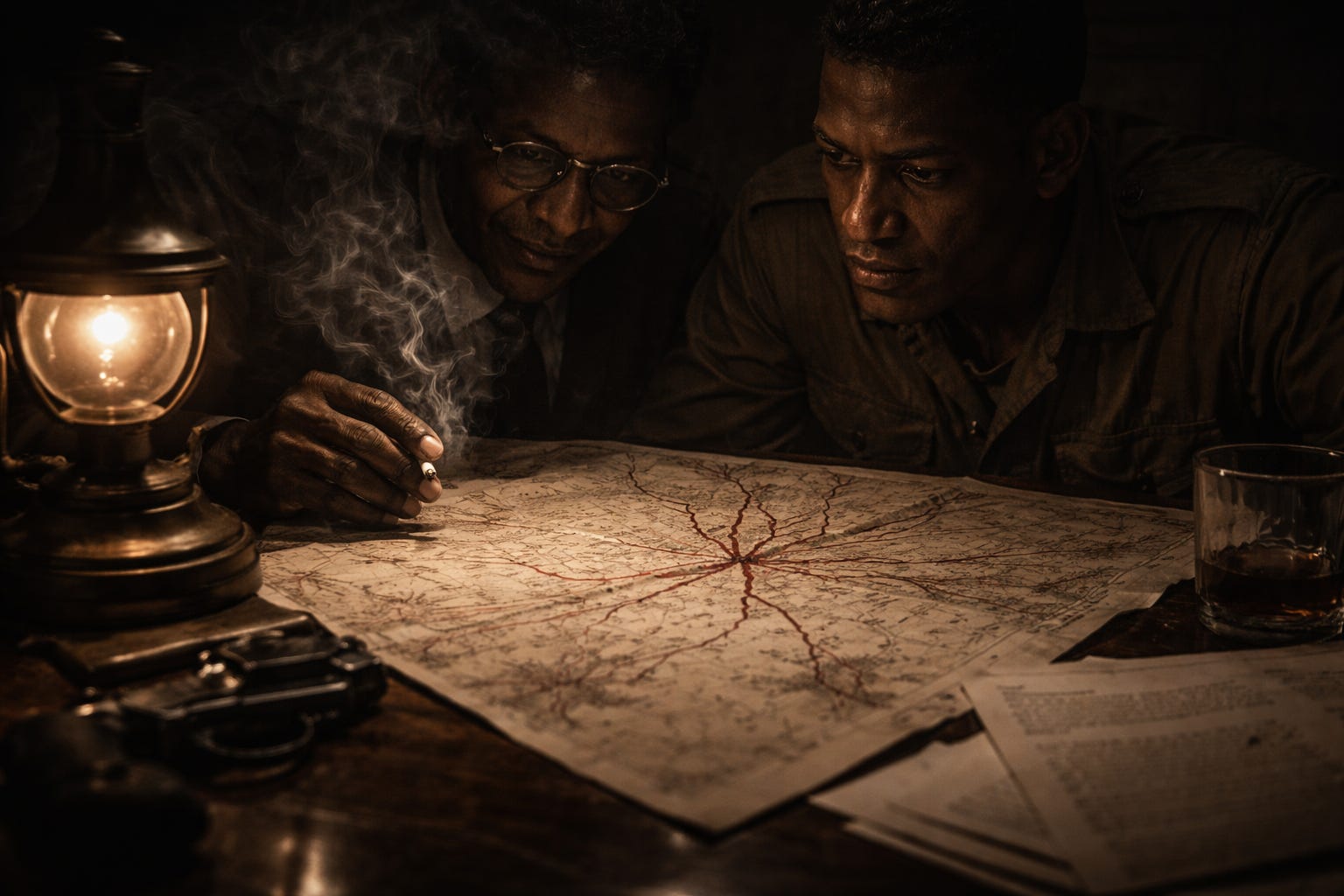
François Duvalier was very much in the thick of it, and he recognized the opening immediately. This was the moment to recruit the one man he had long imagined as his indispensable right hand. Long before Duvalier truly saw himself as presidential material, he had already decided who would one day architect his security apparatus—not because the man was a follower, but precisely because he was not. He admired him for his discipline, his steadfastness, and perhaps most importantly—his habit of questioning rather than obeying.
The two shared a deep hostility to elitism, a commitment to the cause of noirisme, and a belief in Vodou’s ancestral legacy as the nation’s genuine raison d’être. That man was Jean-Michel André.
History is rarely kind to a tyrant’s sycophants. It has little patience for those who later seek absolution by pleading obedience—I was only following orders—as though submission were a moral defense rather than a confession. Jean-Michel André observed from the quietness of the Artibonite valley like a seasoned poker player. Until now, he’d been careful not to fall for the doctor’s slowly built cult of personality. He never saw the doctor as a savior; he didn’t believe in saviors. “Chak neg sove poul ou”—every man for himself—was a motto he practiced in life.
What he’d started to believe was that the movement the doctor was attempting to usher into the fabric of Haitian politics was the noblest of causes, and that was worth fighting for. Jean-Michel didn’t believe there was anything radical about the idea that a functional nation needed the participation of all citizens in the democratic process. He simply wanted to see the high-achieving potential of the motto etched in Haiti’s coat of arms, “L’union Fait la Force” (Unity Makes Strength), made as real as possible.
But the Mulatto elite wanted to sell a different story, one predicated on the notion of “ti neg pa ka konn pouvwa”—the common man cannot handle power—and the prefect wasn’t having any of it. He was ready to make “pouvwa pou ti neg”—power for the common man—something real, and ready for vengeance, should that become necessary.
The chaos in Port-au-Prince was the signal Jean-Michel always thought he needed to enter the field of war. He was ready for battle, and he was not afraid of blood. François Duvalier understood this about Jean-Michel and, in his way, respected it. The Doctor never attempted to sell himself as the cause, nor did he insult Jean-Michel’s intelligence with the trappings of an emerging cult of personality. Instead, he offered something far more deliberate: an alliance. A partnership. A shared project in which power was not demanded through devotion, but made possible through mutual recognition.
The Letter: Port-au-Prince, 14 Juin, 1957
Mon cher ami,
I hope that upon receiving this letter, you find yourself in good health. I send my affectionate greetings to you and to your family. Here in Port-au-Prince, I know you are already aware of everything unfolding officially. Still, it is important to me to share with you the true state of affairs in a more personal, more direct manner—through this letter, which I address to you in complete confidence.
I must first confess that today, more than ever, our revolution—our divine plan—finds itself in a state of extreme fragility. The fruits of our efforts may well be compromised by ill-intentioned individuals, the very same who only yesterday claimed to be our allies, and who today no longer hesitate to barter the nation’s future in order to preserve their own privileges.
I sense around me a new agitation. Persistent murmurs. Averting gazes. None of this is without consequence. When one draws closer to the truth, those who live within falsehood become dangerous. I write to you, therefore, not out of fear—but out of clarity.
Through our alliance, our friendship, and our good-faith association, we were able to safeguard the health of an entire community, without ever having to request a single favor from those who had already turned their backs on the population of the Artibonite Valley. Just imagine, my friend, all that we will still have the opportunity—and the privilege—to accomplish for our compatriots, for our ancestors, and for the noble cause of noirisme.
It is for this reason, my dear friend, that I urge you to join me in Port-au-Prince. It has become impossible for me to continue this historic electoral campaign, knowing that so many others are searching for a single moment of weakness in order to eliminate me. I swear to you that at times, my fear is greater for the safety of my family than for my own.
My heart will know peace only in the certainty that you—my friend, my confidant—will be here. At my side. Hand in hand. Shoulder to shoulder.
Final Reflection
Power is rarely seized in a vacuum; it is invited through the doors of shared grievance and personal loyalty. In writing these letters, Duvalier wasn’t just asking for a bodyguard; he was asking for a witness to his necessity. When the “Doctor” speaks of a “divine plan” and the “sacred duty” of the revolution, he is laying the groundwork for a regime that would eventually blur the lines between political leadership and spiritual mandate. The question remains: at what point does the “alliance of good faith” become a pact with the inevitable?